
You had your cholesterol checked. The numbers came back, your doctor gave them a quick look, and you left with either a pat on the back or a prescription for a statin. Either way, you probably still don’t know the one thing you wanted to know: is your heart actually at risk?
A standard cholesterol test measures how much cholesterol is in your blood. It does not show you the particles that carry that cholesterol into your artery walls, and the number and size of those particles are what actually drive heart disease. An NMR test for cholesterol, also called an NMR LipoProfile, measures them directly. It is one of the first tests I run at Doctor’s Nutrition when a patient is worried about their heart, because it answers the risk question a regular panel leaves wide open.
Why a standard cholesterol test isn’t telling you enough
The basic cholesterol panel has been around since the late 1970s. It was a good test for its time. The trouble is that it still reports the same four numbers it always has: total cholesterol, LDL, HDL, and triglycerides.
Those numbers matter, but they only tell you how much cholesterol is in your blood. They say nothing about how that cholesterol is being carried, and that is where the real risk hides. Two people can have the exact same LDL number and very different odds of a heart attack. The standard test cannot tell those two people apart, and the NMR test can.
What an NMR test for cholesterol actually shows you
An NMR test gives you a level of detail a regular panel simply can’t. It uses nuclear magnetic resonance, the same technology behind an MRI, to scan a small sample of your blood and read the particles inside it. I call it an MRI for your blood, and that is a fair way to picture it.
From one blood draw, it tells you how many cholesterol-carrying particles you have, how many of those are the small dangerous kind, how big they are, how healthy your protective HDL particles are, and even how your body is handling sugar. You still get your familiar total cholesterol, LDL, HDL, and triglycerides. You just finally get the story behind them. As one 2022 medical review summarized, the number of particles tends to predict heart risk better than cholesterol levels do, though that same review is careful to add that we still need more trial data to prove advanced testing improves outcomes.1
There is only one cholesterol. What matters is how it travels
There is really only one kind of cholesterol. The good and bad cholesterol you have heard about are the same cholesterol riding in two different delivery trucks.
Your blood is mostly water, and cholesterol is a fat, so the two do not mix. To move cholesterol around, your body loads it into little trucks called lipoproteins and ships it through your bloodstream to the cells that need it. LDL and HDL are two of those trucks. So labeling one good and one bad misses what really counts: how many trucks are on the road, and how big they are.

Particle size matters, but it is only half the story
One of the most useful things an NMR test shows you is how big your cholesterol particles are, alongside how many you have.
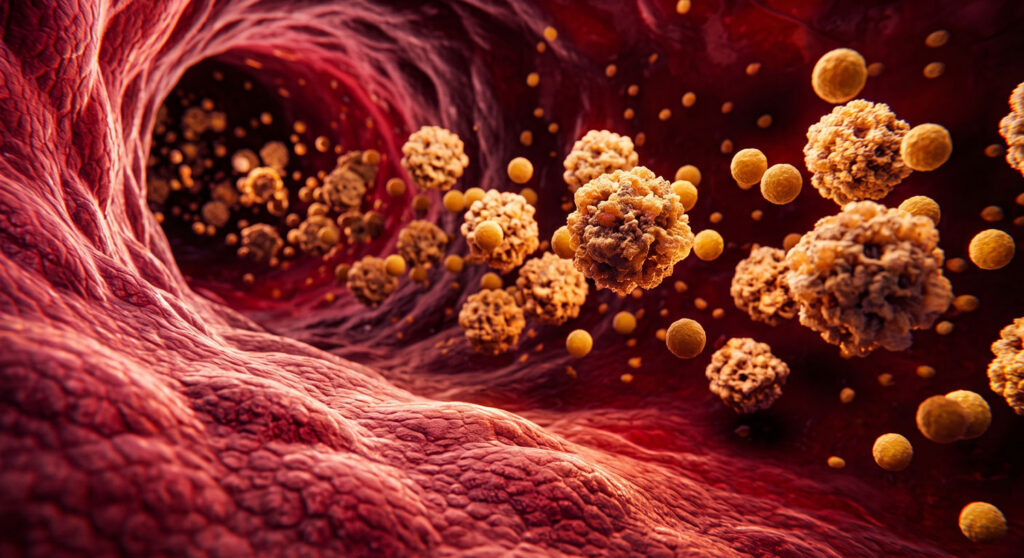
Picture a basketball bouncing off your artery wall. It is big and soft, so it bounces away and moves on. Now picture a small golf ball. It is small and hard, and it can slip into tight spots a basketball never could. That is the difference between a big, fluffy cholesterol particle and a small, dense one.
The golf ball picture is a simple way to see why smaller particles get into places they shouldn’t. The real concern is what happens after they get in. Small, dense LDL particles are more likely to push into the wall of your artery and stay there, where they can oxidize (go rancid) and help build the plaque that narrows arteries.5 Older and newer studies link these small, dense particles with higher coronary risk.4 A 2020 review that pooled 21 studies, more than 30,000 people, and over 5,000 heart events found that higher small, dense LDL went with higher coronary heart disease risk.5
This is part of why two people with identical cholesterol numbers can face very different risk. The NMR test sorts your particles and even gives them a grade: pattern A means mostly big and fluffy, which is what you want, and pattern B means mostly small and dense.
How many particles you have counts just as much
That is only half the story, though. The other half is how many particles you have, called your LDL particle number, or LDL-P. More trucks on the road means more chances for cholesterol to get dropped off in your artery walls.
In the large Framingham Offspring Study, the particle number predicted heart problems better than the standard LDL number did.2 In practice, this is what counts most. Sometimes your regular cholesterol looks perfectly fine while your particle count runs high. When particle number and your standard LDL cholesterol disagree, particle number usually gives the clearer signal of your real risk.3 A standard test would have sent you home thinking you were in the clear. The most useful view is both together, size and number, read alongside your standard cholesterol, rather than any one of them on its own.
Why a high “good cholesterol” can still fool you
You have probably been told that HDL is the good cholesterol and the higher the better. That is mostly true, but a high HDL number does not always mean your HDL is protective. The NMR test can add context by showing how many HDL particles you have, and in one large study the number of HDL particles predicted heart events better than the HDL number on a standard panel.6 Even so, how well your HDL actually works involves more than particle count, things like how well it clears cholesterol from your tissues, so we read it as one more clue rather than the final word.
The blood sugar connection most cholesterol tests miss
There is one more thing the NMR test checks that a standard panel skips completely: how your body is handling sugar. It gives you an insulin-resistance score from 0 to 100, and it is one of the numbers we watch most closely.
Why it matters comes down to a simple chain of events. When you eat a lot of sugar and refined carbs over the years, your cells slowly stop responding to insulin. That is insulin resistance. To keep your blood sugar in check, your body has to pump out more and more insulin to get the same job done. Meanwhile, all that extra sugar in your blood has to go somewhere, and a lot of it sticks to things, including the walls of your arteries, in a process called glycation. Picture sugar caramelizing and hardening onto a surface. That is roughly what it does to your artery walls, leaving them stiff and rough.
And a rough, damaged artery wall is exactly where those small, dense particles tend to lodge. So high blood sugar and harmful cholesterol particles work hand in hand against your heart. That is why the insulin-resistance score is so useful. It can reveal an insulin-resistant pattern even when your fasting blood sugar still looks normal, which is useful information to have early.7
So do you actually need a statin?
This is where the NMR test really earns its place. Plenty of people come to us with cholesterol that is just a touch high, no other red flags, and a doctor who already wants to start them on a statin. Their question is a fair one: do I really need this? The honest answer is that a standard cholesterol test alone cannot tell you.
The NMR test can add useful information to that decision. Cholesterol has essential roles in the body, so whether to start a statin should come down to your overall cardiovascular risk rather than your LDL cholesterol alone.
A favorable NMR profile may shift the risk-and-benefit conversation, and an alarming one can too. Someone whose standard numbers look only a little off can turn out to have a high particle count, plenty of small dense particles, high triglycerides, and a high insulin-resistance score. Either way, the decision still depends on the full picture: your age, your LDL or non-HDL cholesterol or apoB, your blood pressure, diabetes, smoking, family history, a coronary calcium score, and any prior heart history. These are conversations to have with a provider who can weigh all of it with you.1
How we use the NMR test at Doctor’s Nutrition
If your cholesterol has been weighing on you, or a statin decision is hanging over your head, this is where I would start. At Doctor’s Nutrition we run the NMR test at an affordable price, then sit down and read it with you in plain language: how many particles, how big, how healthy your HDL is, and what your blood sugar is doing. From there we build a plan around what your labs actually show, not a generic script.
You can run the NMR test on its own, and plenty of people do. But your heart does not work in isolation, and I don’t read it that way either. Your thyroid, your blood sugar, your hormones, your inflammation, and your nutrient levels all feed into heart health, and a single cholesterol test cannot see any of that.
So in most cases I recommend our Super Cardiac Panel instead of the NMR alone. It puts the whole picture in front of us in one sitting. Along with the NMR cholesterol test, it looks at deeper heart and clotting markers like cardiac CRP, homocysteine, fibrinogen, lipoprotein(a), and oxidized LDL; your blood sugar and metabolism through hemoglobin A1c and insulin; your thyroid and stress hormones through a full thyroid panel, Free T3, DHEA, and cortisol; the nutrients that affect your heart like vitamin D, B12, folate, magnesium, and ferritin; and broad health markers including a CBC, CMP, CK, and a urinalysis.
When we see all of it together, we can find the real root of the problem instead of guessing from one number. That is the whole idea behind how we practice: test first, then build the plan around what your labs actually show.
For a lot of people, the particle picture improves with the right food and lifestyle changes, and I have watched plenty of NMR results move in the right direction. Everyone is a little different, so I will not promise you a specific number. What I will promise is that you will finally understand what your cholesterol is doing and walk out knowing your next step.
Frequently asked questions
What is the difference between an NMR test and a standard cholesterol test?
A standard cholesterol test measures how much cholesterol is in your blood. An NMR test for cholesterol goes further: it counts the particles that carry the cholesterol and measures their size. Because the size and number of those particles predict heart risk better than cholesterol levels alone,1 the NMR gives you a clearer answer than a basic panel can.
Are small, dense LDL particles really that dangerous?
They are the ones most strongly linked to heart disease. Because they are small and dense, they slip into the artery wall more easily and are more likely to oxidize and build plaque than large, fluffy particles.5 Two people with the same LDL number can have very different risk depending on how many small, dense particles they carry, which is why size matters as much as the number.
Is the NMR LipoProfile worth it?
If you are weighing a statin, have a family history of heart disease, or have normal cholesterol but other risk factors, it usually is. It catches the cases where your cholesterol looks fine but your particle count is high.3 For a healthy young person with no risk factors, a standard panel may be enough for now.
Does insurance cover an NMR test for cholesterol?
Coverage varies. Some plans cover advanced lipid testing when you have a documented risk factor, and some do not. Because it costs more than a basic panel, it is worth checking your coverage or asking about cash pricing. We keep our lab pricing affordable so cost is rarely the reason someone skips it.
Can you improve a bad NMR result naturally?
Often, yes, especially the particle picture. Small dense particles and high triglycerides are closely tied to blood sugar and diet, both of which respond well to the right changes. We have seen many NMR profiles improve over time. How much improves depends on where you start and what is driving it, so results vary from person to person.
Your next step
Knowing what an NMR test measures is a good first step. Knowing what your own results say about your heart is the part that actually changes things, and that takes your own lab data. At Doctor’s Nutrition, consultations are always free. You will walk away with a clear picture of where you stand and what your options are, with no pressure and no sales pitch. Just answers.
Book your free consultation: https://doctorsnutrition.com/free-consultation/
References
1. Emeasoba, Emmanuel U., Emeka Ibeson, Ifeanyi Nwosu, Nadine Montemarano, Jacob Shani, and Vijay S. Shetty. “Clinical Relevance of Nuclear Magnetic Resonance LipoProfile.” Frontiers in Nuclear Medicine 2 (2022): 960522. https://doi.org/10.3389/fnume.2022.960522 PMID: 39354981. PMCID: PMC11440956.
2. Cromwell, William C., James D. Otvos, Michelle J. Keyes, Michael J. Pencina, Lisa Sullivan, Ramachandran S. Vasan, Peter W. F. Wilson, and Ralph B. D’Agostino. “LDL Particle Number and Risk of Future Cardiovascular Disease in the Framingham Offspring Study: Implications for LDL Management.” Journal of Clinical Lipidology 1, no. 6 (2007): 583–592. https://doi.org/10.1016/j.jacl.2007.10.001 PMID: 19657464.
3. Otvos, James D., Samia Mora, Irina Shalaurova, Philip Greenland, Rachel H. Mackey, and David C. Goff Jr. “Clinical Implications of Discordance Between Low-Density Lipoprotein Cholesterol and Particle Number.” Journal of Clinical Lipidology 5, no. 2 (2011): 105–113. https://doi.org/10.1016/j.jacl.2011.02.001 PMID: 21392724. PMCID: PMC3070150.
4. Austin, Melissa A., Jacques L. Breslow, Charles H. Hennekens, Julie E. Buring, Walter C. Willett, and Ronald M. Krauss. “Low-Density Lipoprotein Subclass Patterns and Risk of Myocardial Infarction.” JAMA 260, no. 13 (1988): 1917–1921. https://doi.org/10.1001/jama.260.13.1917 PMID: 3418853.
5. Liou, Lathan, and Stephen Kaptoge. “Association of Small, Dense LDL-Cholesterol Concentration and Lipoprotein Particle Characteristics with Coronary Heart Disease: A Systematic Review and Meta-Analysis.” PLOS ONE 15, no. 11 (2020): e0241993. https://doi.org/10.1371/journal.pone.0241993 PMCID: PMC7652325.
6. Mackey, Rachel H., Philip Greenland, David C. Goff Jr., Donald Lloyd-Jones, Christopher T. Sibley, and Samia Mora. “High-Density Lipoprotein Cholesterol and Particle Concentrations, Carotid Atherosclerosis, and Coronary Events: MESA (Multi-Ethnic Study of Atherosclerosis).” Journal of the American College of Cardiology 60, no. 6 (2012): 508–516. https://doi.org/10.1016/j.jacc.2012.03.060 PMID: 22796256.
7. Shalaurova, Irina, Margery A. Connelly, W. Timothy Garvey, and James D. Otvos. “Lipoprotein Insulin Resistance Index: A Lipoprotein Particle-Derived Measure of Insulin Resistance.” Metabolic Syndrome and Related Disorders 12, no. 8 (2014): 422–429. https://doi.org/10.1089/met.2014.0050 PMID: 24959989.
